 Ferriskey
Account
Everything else in FerrisKey is an administrator acting on someone. The account module is the opposite: it is the surface a user operates on themselves, and the only one where the caller and the target are the same person by construction.
That distinction is the whole design. These endpoints live under /users/me, they resolve the subject from the caller’s own token, and they take no user id — so there is no id to tamper with and no permission to hold. A user needs no manage_users to change their own password, and holding manage_users grants nothing extra here.
What a user can do
| Area | Operations |
|---|---|
| Profile | Read and update their own name and email, set their locale |
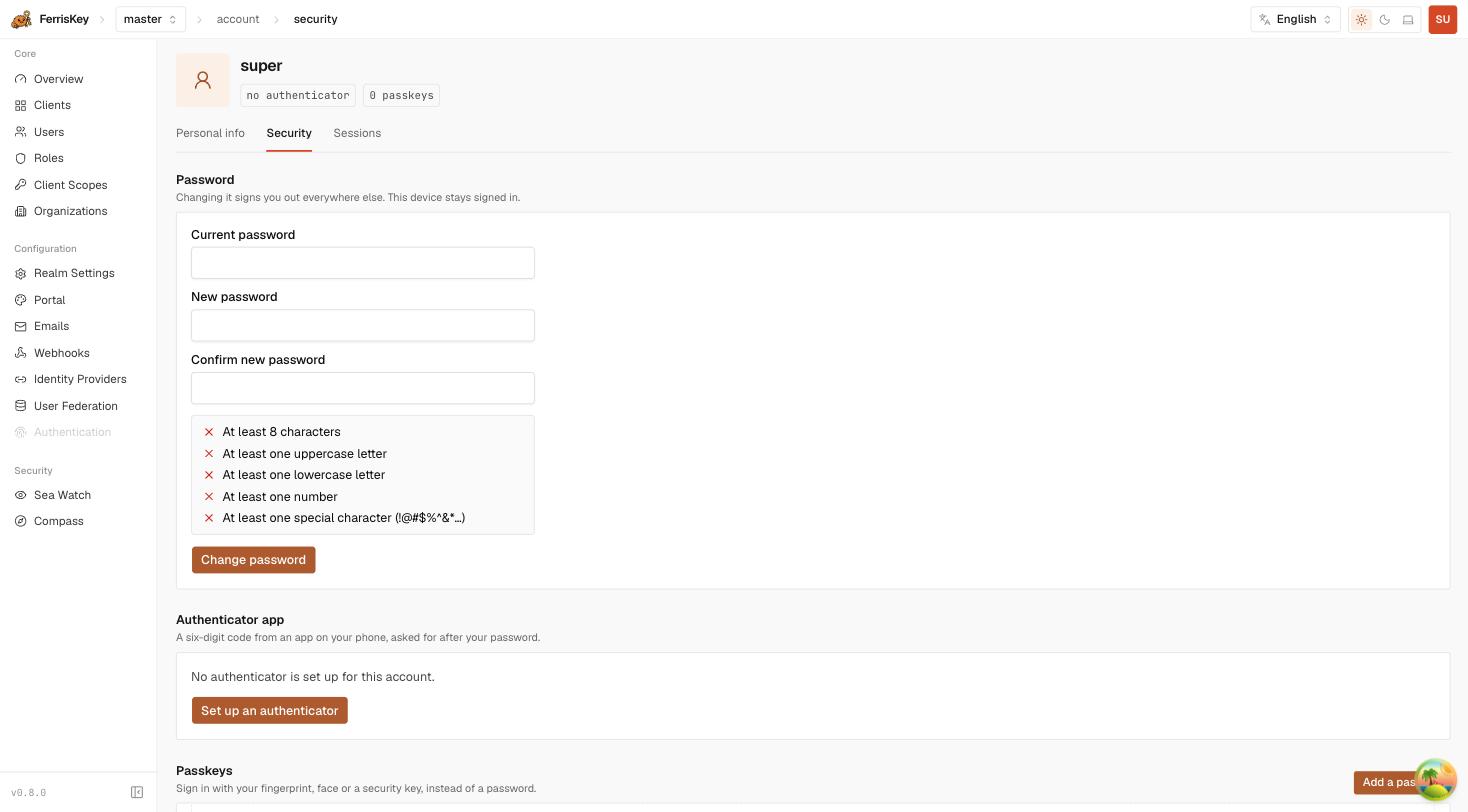
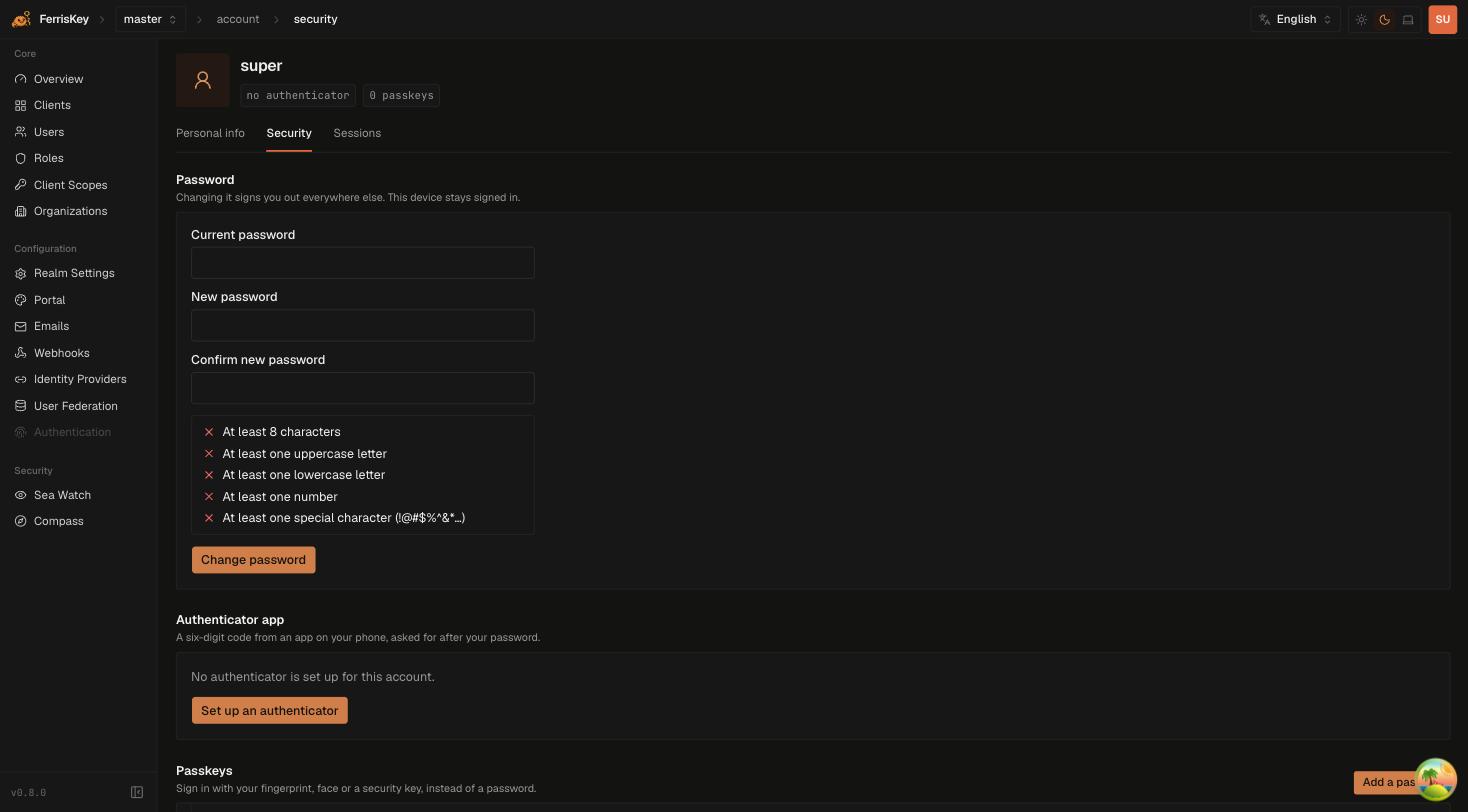
| Password | Change it, against the realm’s password policy |
| Authenticator app | Enrol a TOTP authenticator, confirm it, remove it |
| Passkeys | Register a passkey, list credentials, delete one |
| Sessions | Review their active sessions |
Profile
GET /realms/{realm_name}/users/me
PUT /realms/{realm_name}/users/me
What a user may change about their own profile is not fixed: the realm decides. edit_username_enabled governs whether the username field is writable, and the console shows it as locked when the realm says no.
Email is the field to think about, because it is also the recovery address. When email_verification_enabled is on, changing it puts the account back through verification rather than trusting the new address immediately.
Locale
PUT /realms/{realm_name}/users/@me/localeSets the locale used for this user’s login portal and emails, from the realm’s supported_locales. With no preference stored, the realm’s default_locale applies.
This one path says @me, not me
Every other account endpoint is spelled /users/me. The locale endpoint is /users/@me/locale, as is GET /users/@me/realms. It is an inconsistency in the current API, not a typo in this page — code against it as written.
Sensitive operations need an elevation
Reading your profile needs nothing beyond a valid token. Changing a credential needs proof that the person at the keyboard is still the account holder, and not someone who found an unlocked laptop.
POST /realms/{realm_name}/users/me/reauthenticateSupply exactly one of password or otp_code. The response carries an elevation_id and an expires_at; the elevation lives five minutes and is bound to the calling session. Every sensitive operation then takes that elevation_id.
{
  "elevation_id": "01a0d3dd-a750-7f0f-91d9-cf05f19168c6",
  "expires_at": "2026-09-24T18:42:11Z"
}
A second factor cannot rotate the factors
Adding, replacing or removing a sign-in credential requires the elevation to have been proved with a password, not with an OTP code. Otherwise a stolen second factor could enrol itself as the only factor and lock the owner out — a factor must not be able to rotate the set it belongs to, including itself.
Changing the password is the exception: it carries the current password in the request body, which is the same proof by another route.
Security covers each operation and the order to call them in.
What this surface deliberately does not do
- No credential reset for someone else. That stays an administrative operation, under
manage_users. - No role or organization changes. A user cannot grant themselves anything.
- No account deletion. Self-service deletion is not exposed.
- No recovery-code generation. Recovery codes are issued during the MFA challenge, not from the account page.