 FerrisKey
Paginated listings
Nineteen list endpoints of the API return one page at a time and share a single contract. The same query parameters, the same response envelope and the same errors apply to all of them, so a client written for the users list works for roles, clients, webhooks and the rest.
The request
| Parameter | Default | Meaning |
|---|---|---|
page | 1 | The page to return, starting at 1 |
limit | 20 | Items per page, from 1 to 100 |
order_by | created_at | The column to sort on. The accepted values depend on the endpoint, see the table below |
order | desc | asc or desc |
On top of these, each endpoint accepts its own filters. A value that is out of range is refused, not clamped: limit=101 is a 400, not a page of 100.
GET /realms/acme/users?enabled=true&order_by=username&order=asc&page=2&limit=2The response
The body is always { data, metadata }. data holds up to limit items of the resource, and metadata describes where the page sits.
{
  "data": [
    // up to 2 users
  ],
  "metadata": {
    "page": 2,
    "limit": 2,
    "total": 30,
    "total_pages": 15,
    "first_page": 1,
    "last_page": 15,
    "next_page": 3,
    "prev_page": 1
  }
}
total counts every item that matches the filters, not only the ones on this page. next_page is null on the last page and prev_page is null on the first. When nothing matches, total_pages is 0 and last_page is still 1, so first_page and last_page are always safe to link to.
Filters
The filters differ per endpoint, but they behave the same way:
- A text filter, such as
nameoremail, matches anywhere in the value and ignores case. searchlooks across the main text fields of the resource at once. Which fields depends on the endpoint.- Booleans and enumerations, such as
enabledorstatus, match exactly. Booleans aretrueorfalse. idstakes a comma-separated list of at most 100 ids.created_fromis inclusive andcreated_tois exclusive. Both take an RFC 3339 date-time with a time and an offset, for example2026-10-01T00:00:00Z. A range that ends before it starts returns an empty page.- Filters combine with AND.
- A filter with an empty value is ignored.
The time bounds on the security events and on the authentication flows have their own names, from_timestamp and to_timestamp for SeaWatch and from and to for Compass. Both bounds are inclusive.
Sorting on a column that can be empty, such as last_seen_at on sessions or last_sync_at on federation providers, puts the rows without a value last in ascending order and first in descending order.
Errors
A parameter the endpoint does not know is refused with 400 and the reason invalid_query, and the message names it. That includes offset, which no listing accepts, SeaWatch and Compass included: use page and limit.
{
  "code": "E_BAD_REQUEST",
  "status": 400,
  "reason": "invalid_query",
  "message": "Invalid query parameter `offset`: unknown field `offset`, expected one of `search`, `username`, `email`, `firstname`, `lastname`, `enabled`, `email_verified`, `service_account`, `role_id`, `ids`, `not_in_group`, `not_in_organization`, `created_from`, `created_to`"
}
The same 400 covers a page below 1, a limit outside 1 to 100, an order that is not asc or desc, an order_by the endpoint does not offer, a value of the wrong type (a UUID filter that is not a UUID, a boolean that is not true or false), a filter that appears twice, and an ids list longer than 100. See API errors for the error shapes.
The endpoints
Every path below starts with /realms/{realm_name}. All of them take search, page, limit, order_by and order, plus the filters in the last column.
| Endpoint | order_by | Other filters |
|---|---|---|
GET /users | username, email, firstname, lastname, enabled, created_at, updated_at | username, email, firstname, lastname, enabled, email_verified, service_account, role_id, ids, not_in_group, not_in_organization, created_from, created_to |
GET /users/@me/realms | name, created_at, updated_at | name, display_name |
GET /users/{user_id}/sessions | last_seen_at, expires_at, created_at | ip_address, user_agent, persistent, created_from, created_to |
GET /clients | name, client_id, enabled, created_at, updated_at | name, client_id, client_id_exact, enabled, public_client, service_account_enabled, oauth_device_code_grant_enabled, protocol, client_type, application_type, has_redirect_uris, maintenance_enabled, ids, created_from, created_to |
GET /client-scopes | name, created_at, updated_at | name, description, protocol, default_scope_type, has_protocol_mappers, not_assigned_to_client, created_from, created_to |
GET /roles | name, created_at, updated_at | name, qualified_name, description, require_mfa, client_id, scope, has_permissions, ids, created_from, created_to |
GET /organizations | name, alias, enabled, created_at, updated_at | name, alias, domain, description, enabled, has_domain, without_member, ids, created_from, created_to |
GET /organizations/{organization_id}/members | username, email, created_at | username, email, enabled, created_from, created_to |
GET /organizations/{organization_id}/groups | name, created_at, updated_at | name, description, parent_group_id, is_root, ids, created_from, created_to |
GET /organizations/{organization_id}/groups/{group_id}/members | username, email, created_at | username, email, enabled, created_from, created_to |
GET /identity-providers | alias, display_name, provider_id, enabled, created_at, updated_at | alias, display_name, provider_id, enabled, health, created_from, created_to |
GET /federation/providers | name, priority, enabled, last_sync_at, created_at, updated_at | name, provider_type, provider_family, enabled, sync_enabled, synced, sync_mode, created_from, created_to |
GET /webhooks | name, endpoint, triggered_at, created_at, updated_at | name, endpoint, triggered, has_subscribers, secure_endpoint, created_from, created_to |
GET /webhooks/{webhook_id}/deliveries | status, attempt_count, last_attempt_at, created_at, updated_at | event, status, resource_id, created_from, created_to |
GET /email-templates | name, email_type, created_at, updated_at | name, email_type, created_from, created_to |
GET /portal/themes | name, created_at, updated_at | name, layout_id, activatable, created_from, created_to |
GET /portal-layouts | name, created_at, updated_at | name, is_default, in_use, ids, created_from, created_to |
GET /seawatch/v1/security-events | event_type, status, timestamp, created_at | actor_id, client_id, event_types, status, target_type, ip_address, from_timestamp, to_timestamp |
GET /compass/v1/flows | status, started_at, duration_ms, created_at | client_id, user_id, grant_type, status, ip_address, identified, completed, from, to |
created_at is the creation date everywhere, except on the two member lists, where it is the date the user joined the organization or the group. GET /users/@me/realms lists the realms the caller can reach, so it takes no date bounds. A few filters have a rule worth reading in the endpoint’s description in the API reference, for instance application_type on clients, health on identity providers and activatable on portal themes.
In the console
The tables of the admin console that show these lists share one layout. Each filterable column has its own filter in the column header, next to the sort arrows, and a single search box sits above the table. There is no separate filter bar.
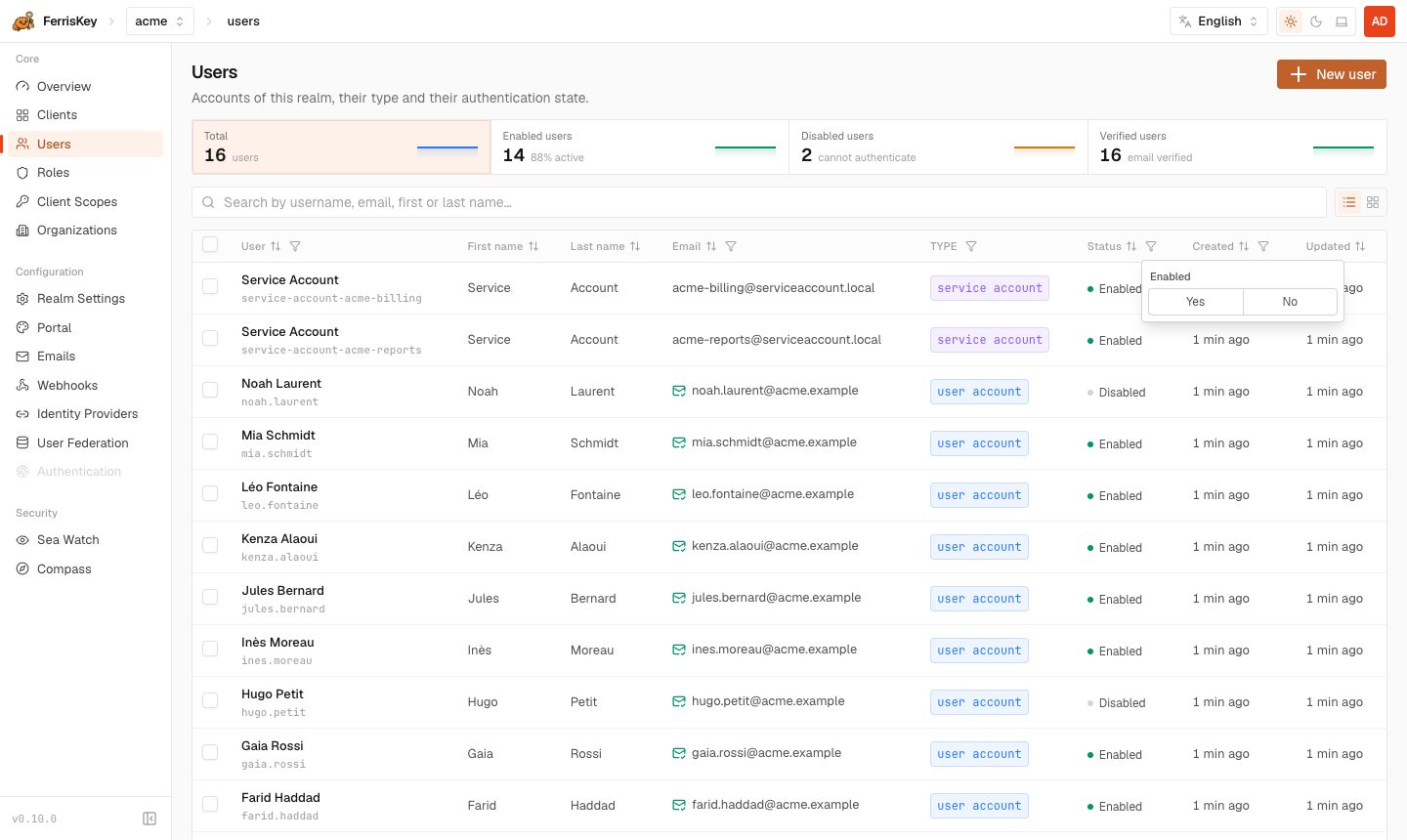
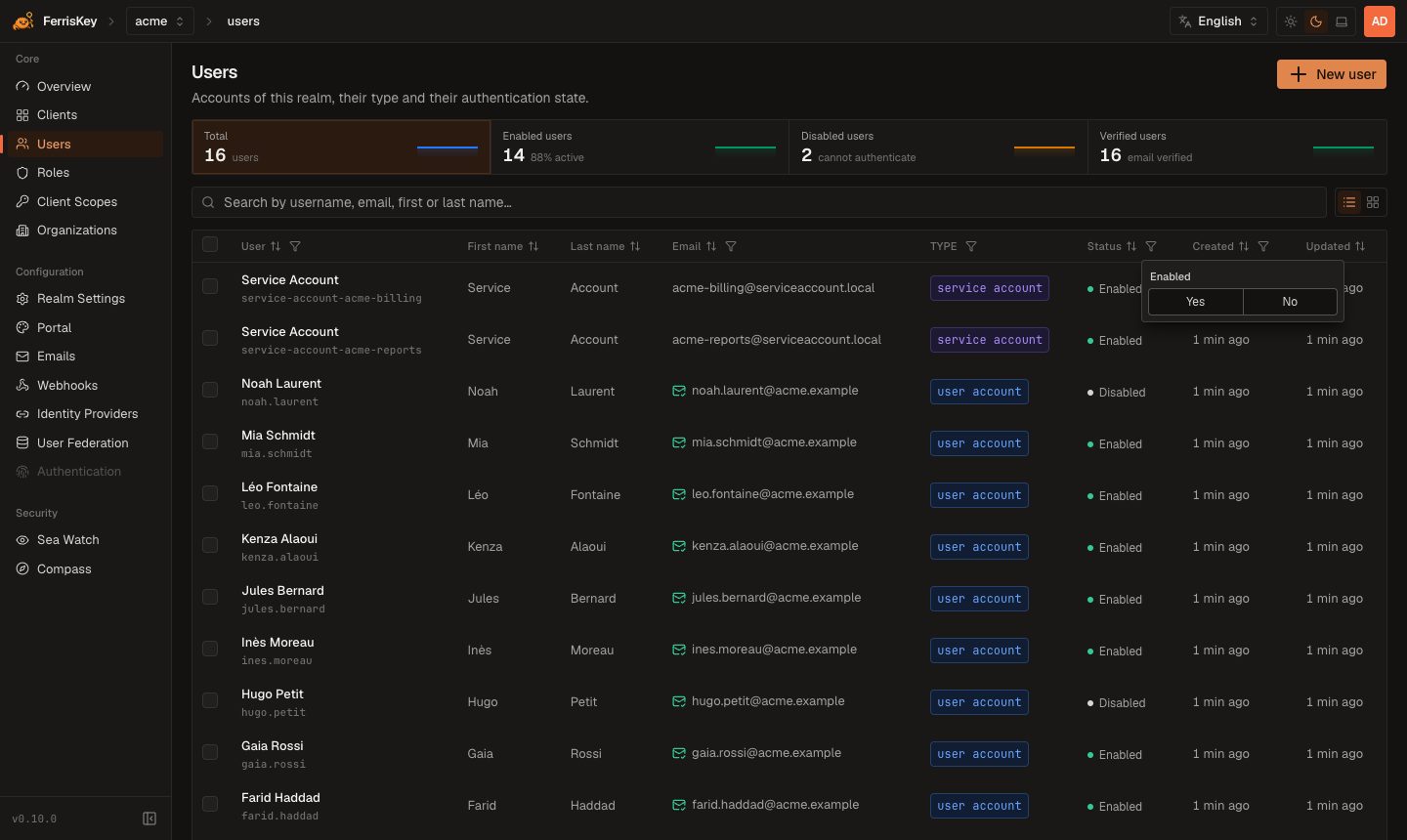
The state of a listing lives in the address bar, under the same names as the API: page, limit, order_by, order and the filters. A filtered, sorted view can be copied as a link, and reloading the page keeps it. Typing in the search box waits 300 milliseconds before it queries, and changing a filter or the sort goes back to page 1.
ferris-ctl stops at the first page
ferris-ctl reads the data of the first page and does not ask for the next, so its list subcommands return at most 20 items. See the CLI overview.